
Parking
Visitor parking management, without becoming the enforcer
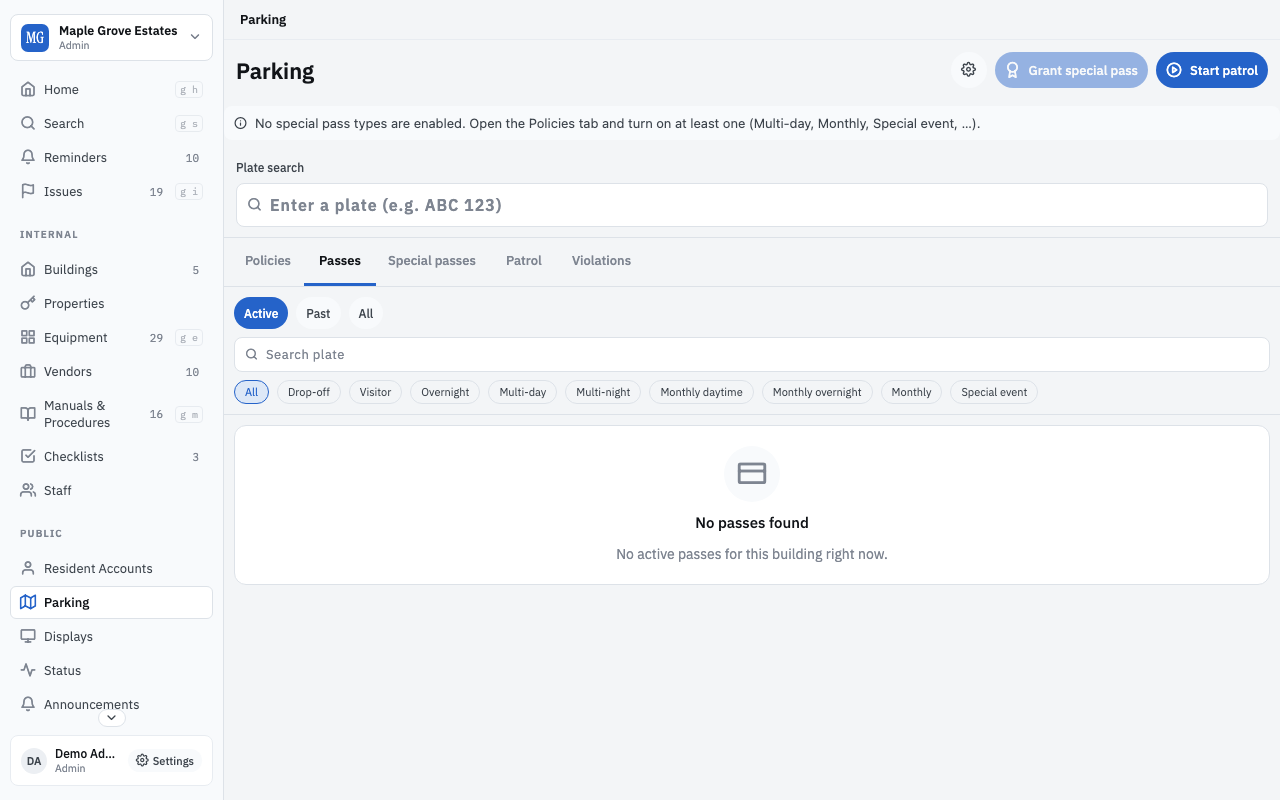
Visitor parking is the single most emotionally-charged operational issue in most small buildings. BuildingHQ separates the three things a working system needs: residents register their own passes, patrol enforces with a phone lookup, and the board reviews unmatched plates in bulk instead of real-time.
The three separations
Every failing visitor-parking system merges what a working one separates:
Registration is a resident action
The resident hosting the guest opens the portal, enters the plate, chooses a duration. The board isn't in the loop for routine passes.
Enforcement is a lookup
Patrol scans a plate on their phone. Five seconds later: matched or unmatched. No calls to the board.
Review is a batch decision
Unmatched plates go to a queue. The board reviews weekly and issues warnings, fines, or dismissals in bulk — not in real- time confrontations.
Pass types built for the passes small buildings actually issue
Most buildings have six to eight distinct pass types, whether they've named them or not. Explicit pass types prevent 80% of the drama.
- Regular visitor — a few hours, self-serve, generous monthly quota.
- Overnight guest — one to two nights, tighter quota, still self-serve.
- Multi-night guest — three to seven nights, may require board attestation above a threshold.
- Monthly guest — thirty-day pass for medical care, renovation contractors, extended visitors. Requires paperwork.
- Contractor pass — business hours only, tied to a specific project.
- Special event pass — a resident's party or gathering, board-approved, time-boxed.
- Secondary vehicle pass — resident owns a car they use rarely and stores in visitor.
Every type has its own quota, its own maximum duration, its own approval rules. Configurable per building. Nothing you don't use shows up in the resident portal.
Patrol on a phone, not a walkie-talkie
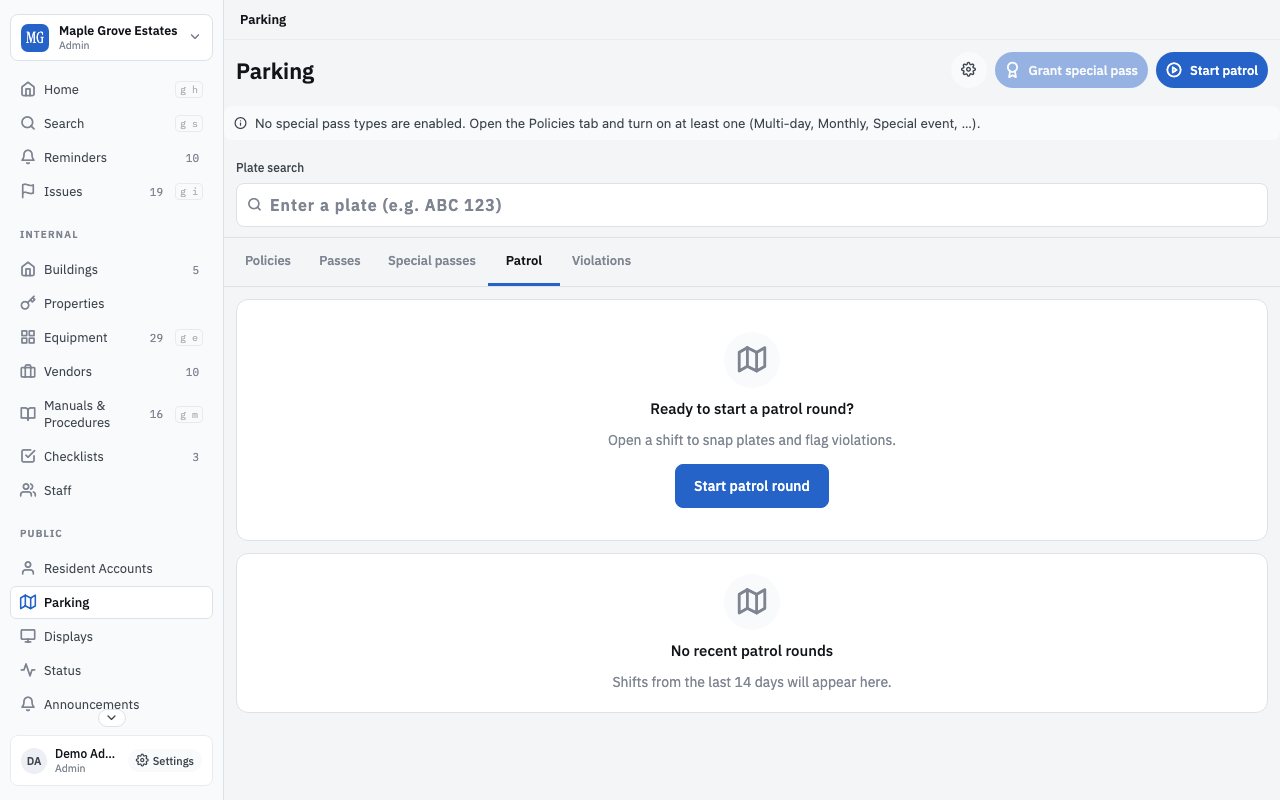
A patrol volunteer or paid service opens a shift in the app, walks the lot, and taps each plate into a lookup form (or points the camera at the plate for OCR-assisted entry). Every plate is one of:
- Matched — an active pass. Logged and moved on.
- Unmatched — no active pass. Photographed with location noted. Surfaces on the board review queue.
- Frequent repeat unmatched — a plate that has appeared unmatched multiple times. Surfaces at higher urgency.
Patrol shifts are logged with a duration and coverage summary (how many plates scanned, how many unmatched). If patrol is a paid service, the invoice matches the log.
Abuse detection without punishing honest residents
Most parking problems come from one or two units systematically abusing the pass system — using visitor passes for a second car, hosting unreported roommates, running a short-term rental. A working system catches this without making everyone else fill in forms.
- Quotas per unit are visible. The unit that's at 40 passes a month while everyone else is at 3 stands out.
- Same plate + same unit + many nights surfaces automatically as a pattern, not a coincidence.
- Long-duration passes require explicit review. The 30-day "medical care" pass that renews forever gets caught.
Pricing
Visitor parking is part of the Standard and Pro tiers. Standard is $39/month base plus $0.50 per resident account. Standard covers up to 250 resident accounts; Pro removes the cap. Both are free to try for 30 days (Standard) or 14 days (Pro), no credit card.
Frequently asked questions
Do residents need to install an app?
No. Residents register a visitor pass from the resident portal in a browser. Any device — a phone, a laptop, a tablet. No install, no store review, no push permission prompt.
How does patrol work?
A patrol volunteer or paid service opens a shift in the app, walks the lot, and scans plates with their phone. Every plate is looked up in real time; matched plates are logged, unmatched ones surface as a violation candidate for board review.
Is the board making tow decisions in the middle of the night?
No. Enforcement is a batch decision, not a real-time confrontation. Unmatched plates go to a review queue. The board reviews once a week (or daily during high pressure) and issues warnings, fines, or dismissals in bulk. Immediate tows are reserved for genuinely obstructive cases.
What pass types does it support?
Visitor passes (a few hours), overnight, multi-night guests, monthly guests (medical care, contractors), contractor passes (business hours only), special-event passes, and secondary-vehicle passes for residents. Each pass type has its own quota, duration, and approval rules — configurable per building.
How do you catch abuse?
Abuse detection is a byproduct of the registration system. Quotas per unit are visible; the same plate showing up night after night from the same unit surfaces automatically; long-duration passes require explicit review. When one unit is at 40 passes a month and everyone else is at 3, the board sees it.
Can guests self-register?
No — a resident hosts the guest and takes responsibility for the pass. This is deliberate: it puts the fraud risk on the resident, not the guest, and keeps the board out of the loop for routine visits.
What if we don't have visitor parking?
The parking surface is optional. If your building has no visitor stalls, you can turn off the entire parking module and the resident portal doesn't show it.
Related reading
- The visitor parking problem (and how to stop being the enforcement person)
- How to talk to residents without inviting an email storm
Turn visitor parking from a personal grievance into a system. 30-day free trial, no credit card.
Start free